
Use box IDs that do not depend on a room name
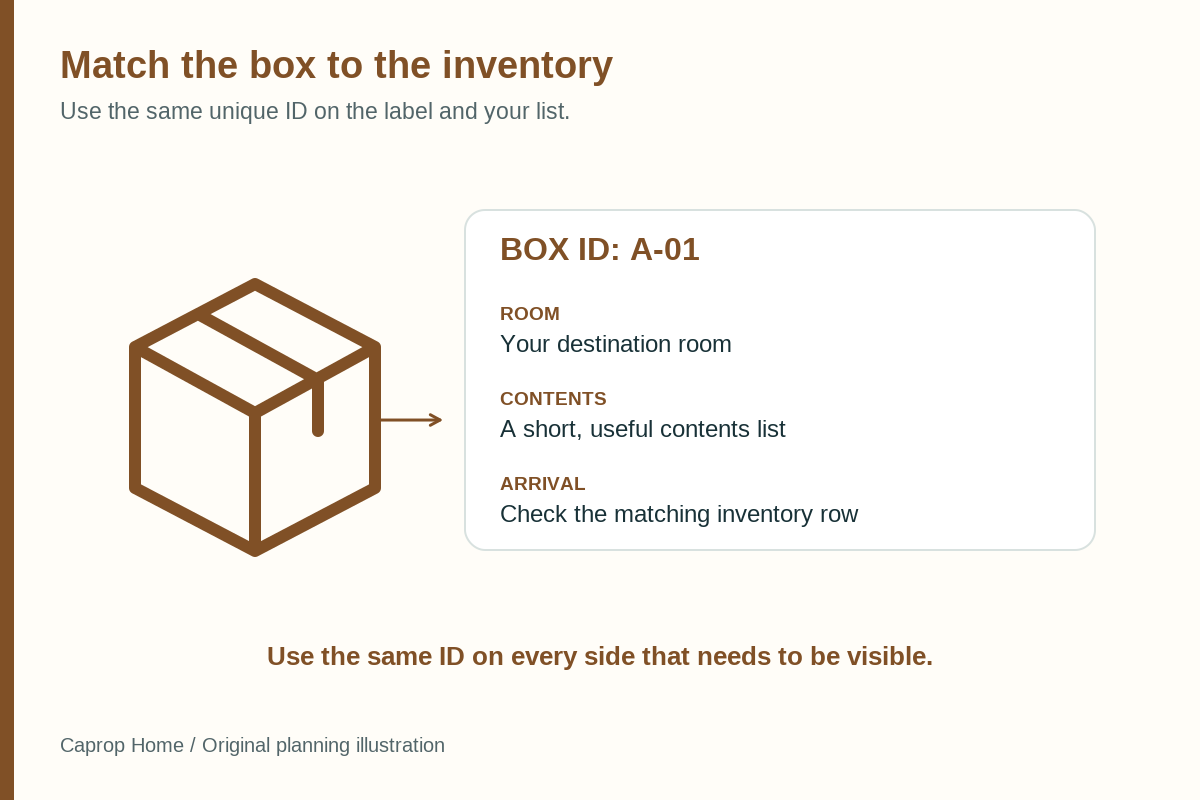
Number boxes with a short sequence such as BX-001. Record the destination room separately. If you decide that office supplies belong in a different room, the box still matches the inventory. Write the ID on more than one visible side so you can identify it in a stack.
The inventory is a finding aid. It does not need a detailed list of every pencil. Use descriptions that distinguish similar boxes, such as “desk stationery and spare notebooks” versus “device cables and adapters”.
Record contents while packing
Keep the inventory beside the packing area and add the entry before sealing each box. If someone else packs, ask them to use the same fields. An open box can change contents quickly, so mark it packed only after the description is final.
Use an early-open flag for items you intend to retrieve soon. Keep essential items and documents in an appropriate separate arrangement rather than assuming an inventory alone makes them accessible. Follow the mover’s packing and prohibited-item instructions for the actual move.
Make the label and list agree
A useful label has the box ID, destination and a brief contents category. The detailed list can include more information without exposing it on the outside. Avoid placing sensitive personal details on visible labels.
Illustrative example: BX-014 is labeled “Study — desk supplies”. The private list says “notebooks, stationery tray, spare labels”. If the box is moved to a storage cupboard temporarily, update the current-location field while preserving the intended destination.
Close the loop at arrival
- Check box IDs against the packed list as they arrive.
- Mark temporary locations when boxes cannot go directly to their destination.
- Use the early-open flag to choose a practical unpacking order.
- Mark a box unpacked only after its contents have been dealt with.
- Keep missing-box and missing-item notes distinct: they require different searches.
Moving inventory
| Box ID | Contents summary | Destination / current place | Status |
|---|---|---|---|
| BX-001 | Example: daily desk supplies | Study / packing area | Open |
| BX-002 | Example: spare serving items | Kitchen / packed stack | Packed |
| Your box |
Put the plan to work
Use your own information to make a practical next step.
Open the planning worksheetSources and review
This guide is an original planning resource. Its worksheets and examples are organizational aids, not a report of product testing or verified customer results.
An original organizational worksheet and workflow. Examples are illustrative, not reports of customer results.
How these guides are prepared